
Every spring, San Diego business and homeowners start seeing something that stops them cold. A cloud of winged insects pouring out of the walls, the ceiling, or the ground around their home. Phones start ringing. People are getting concerned. They don’t know what is happening. Should they be worried or not and honestly, they should pay attention, but they don’t need to panic. Not if they know what they’re looking at.
We are License To Kill Termite and Pest Control, and we have been doing this since 1997. Here’s what you need to know right now.
What Is a Termite Swarm?
A termite swarm is when a colony sends out its reproductive members know as supplemental termites aka “swarmers” or “alates”. These termites job is to find new places to start new colonies. They have wings, they fly, and they look a lot like flying ants. They emerge in large numbers, usually on a warm day after a rain, and they don’t last long in the open air. Within 30 minutes to an hour, most of them are dead on your windowsills.
But here’s the thing: a swarm means a mature colony already exists somewhere nearby. So depending on where you are finding them, they could be inside your home. Termite colonies don’t produce swarmers until they are at least 3 to 5 years old. So if you’re seeing a swarm, you’re not catching something early. You’re seeing evidence of something that has been quietly working for years.
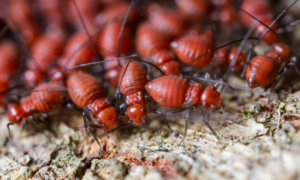
San Diego Has Two Types of Termite and Both Types Swarm.
This is something most people don’t realize. San Diego is one of the few places in the country where you have to deal with two completely different termite species.
Drywood Termites live entirely inside the wood. They don’t need contact with soil. They get into your home through tiny cracks, gaps around window frames, or unfinished wood. You’ll find them in attic framing, furniture, window trim, and fascia boards. Their swarmers tend to emerge in late summer and fall, but in warmer years like we’ve been having, you can see activity as early as spring.
Subterranean termites live in the soil and travel up into your home through mud tubes they build along your foundation. They’re responsible for more structural damage nationally than drywood termites, and they swarm in spring — typically January through April in San Diego, triggered by warm weather and moisture. If you’re seeing swarmers right now in late April, subterranean termites are the most likely culprit.
Knowing which one you’re dealing with changes everything about the treatment. That’s why a proper inspection matters here and not a merely a guess that things are ok.
Flying Ants vs. Termite Swarmers — How to Tell the Difference.
We get this question constantly. Here’s a simple way to tell them apart:
* Termite swarmers have straight antennae, a thick waist, and two pairs of wings that are equal in length.
* Flying ants have bent (elbowed) antennae, a pinched waist, and wings where the front pair is noticeably larger than the back pair.
If you’re unsure, don’t guess. Take a clear pictures, zoom in, place a dime next to it so you can compare to actual size. Take some clear tape and save one, or you can sweep some up, put them in a sealed bag, and call us. We’ll tell you exactly what you’re looking at no charge for that conversation.
What To Do If You See a Swarm
Don’t spray them with insecticide. This is the most common mistake. Killing the swarmers doesn’t touch the colony. It’s like unplugging a smoke detector instead of looking for the fire. The swarmers are just the messengers.
Don’t ignore it. We understand — they disappear fast, and it’s easy to tell yourself it was nothing. But a swarm is the colony telling you it’s healthy and expanding. That’s not good news for your home or business.
Do take a photo or save a few dead swarmers. This helps us confirm the species and give you accurate information when you call.
Do call for an inspection. A licensed termite inspector can assess the situation, identify the species, locate the active areas, and give you a clear picture of what you’re dealing with. So before you spend a dollar on treatment. Know what is going on.
How We Handle It
License to Kill has been a family-owned, Christian business serving San Diego County since 1997. We don’t upsell. We don’t scare people into treatments they don’t need. We inspect, we tell you exactly what we found, and we give you an honest recommendation.
We employ active licensed Branch 2 and Branch 3 Field Representative through the state’s Structural Pest Control Board which govern and police companies approved and authorized to provide license work. Which basically means we’re equipped to handle both drywood and subterranean termites inspections, localized treatments, and full fumigation coordination when it’s truly necessary.
We serve La Mesa, El Cajon, Santee, Lemon Grove, Spring Valley, Lakeside, Rancho San Diego, San Carlos, Alpine, and all of San Diego County.
Don’t Wait Until the Damage Is Obvious
Termites don’t announce themselves. By the time you see buckling floors, hollow-sounding wood, or bubbling paint, the damage is already done and is repairs may already be needed, don’t wait and make those minor repairs become expensive repairs. Believe it or not a swarm is actually a kind of like a small gift, it’s the colony accidentally showing its hand.
If you saw swarmers recently, or if you haven’t had an inspection in the last few years, now is the perfect time to call.
Call us at (619) 447-8216 or contact us through this website. We’ll get you scheduled, tell you exactly what’s happening in your home, and give you a straight answer about what, if anything, needs to be done.
We’ve been your neighbors since 1997. We’re not going anywhere. Let us be the solution.